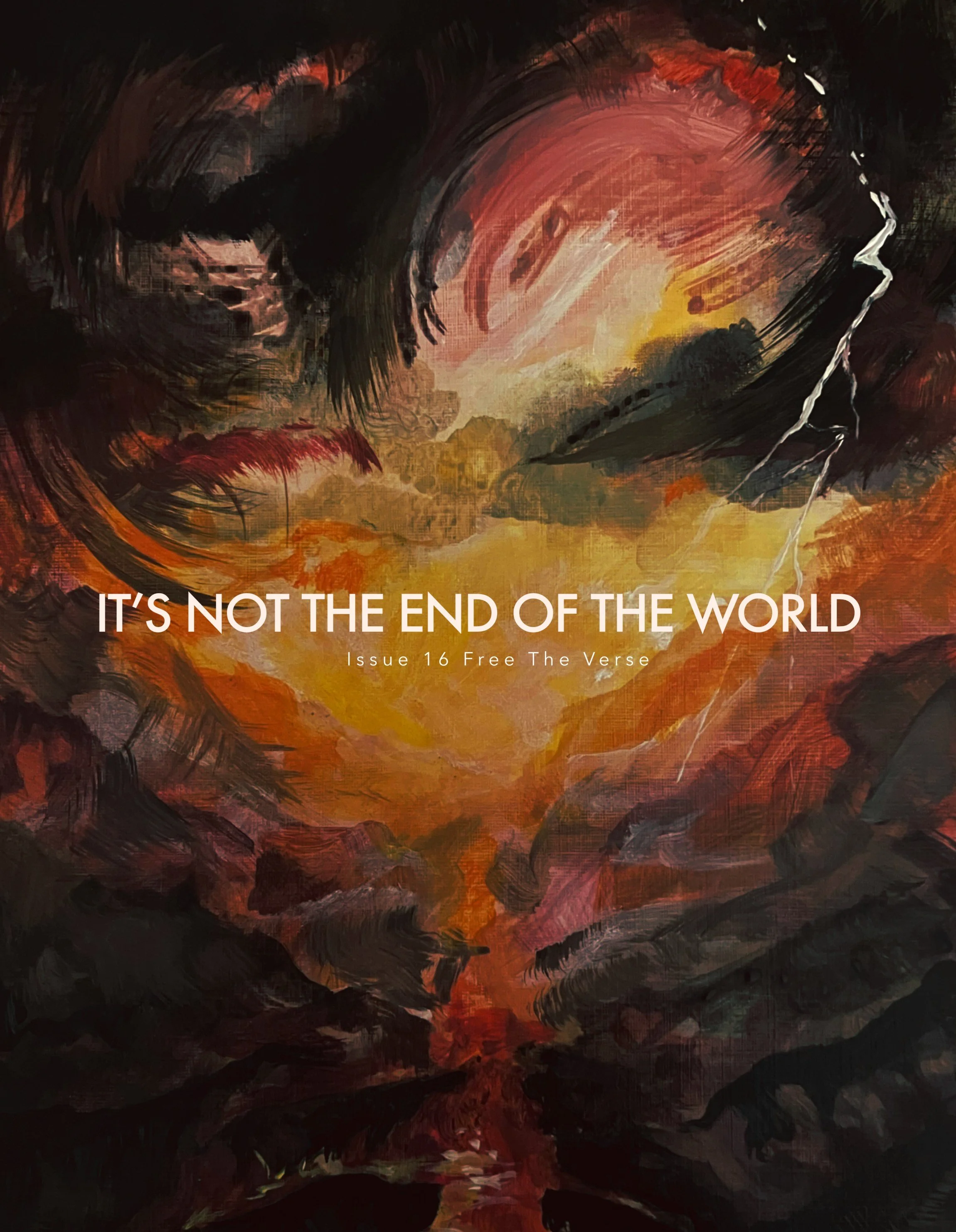
It’s not the end of the world | Issue 16
Table of Contents
Passing the Boneyard — Michael Mintrom
Tae-kwondo — Rebecca Lawn
Gaza (2023) — Hadeel Khaswan
Coming Attractions — Robin Lindsay Wilson
The Wax Paper Cup — James Keegan
In Reverse — Jade Kleiner
When Harmattan Learns to Swim — Oluwanifemi Bakare
Watered Memory — Clement Stern
Valentine’s Day — Rachel Beal
Deus Ex McDonald’s — Milton Chan
Editor’s Note
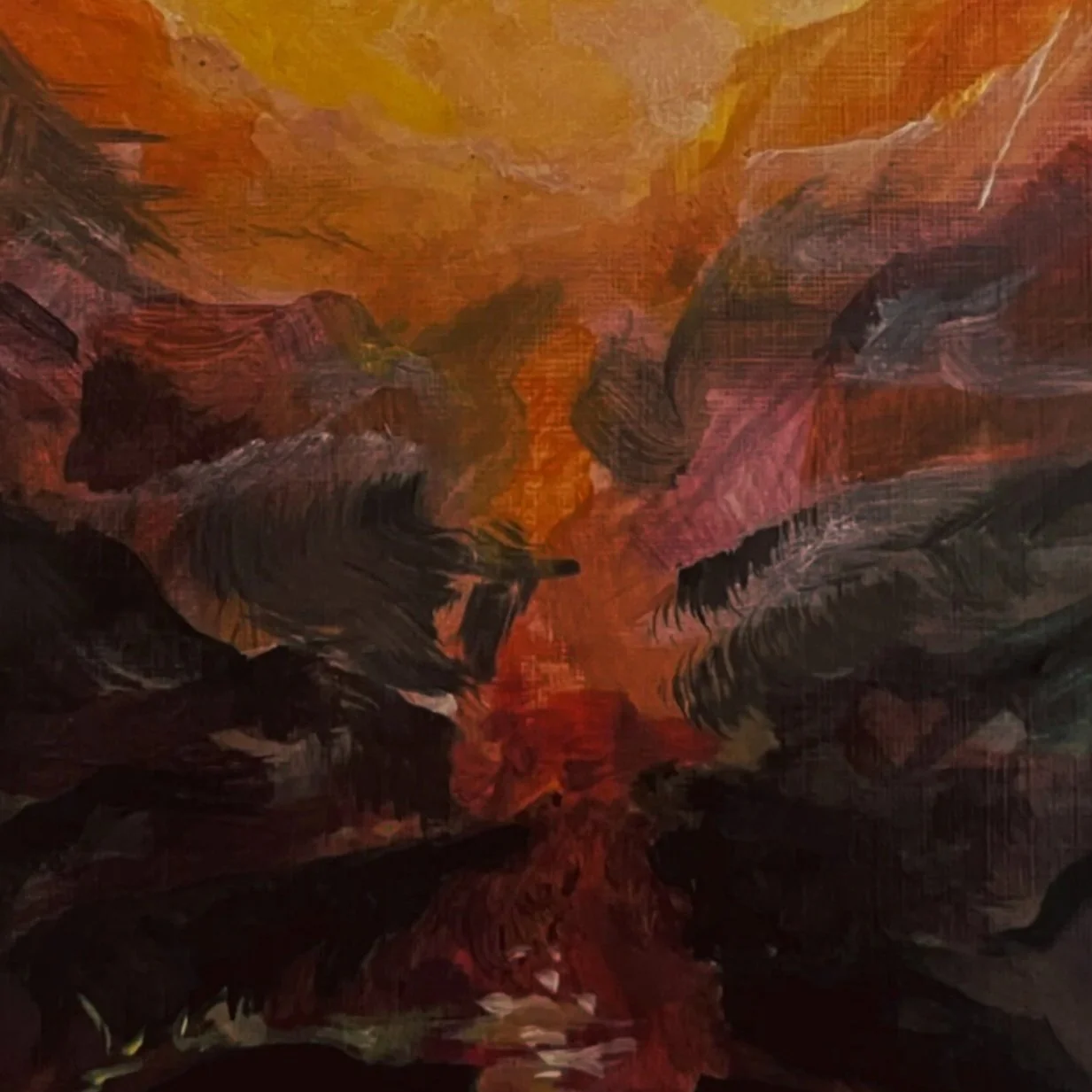
It’s really not. The end, I mean. The fact that the sky keeps falling in on us is irrelevant.
There’s a nervousness within us. A scratching under the surface. A need to write poetry that speaks to that anxiety. To cry out and tell everyone it is the end, and why is the world still spinning? Or to say, it’s not the end, and then ask why the world has stopped.
The origins of the word ‘apocalypse’ lie in the phrase ‘to uncover’. This issue is an uncovering and, like a poem, it unveils as it unfolds.
— Anna Elwin
Art Director
Passing the Boneyard
Michael Mintrom
Driving this road, mostly I look to the Galiuro Mountains
note how the sun highlights peaks and valleys, watch
for local weather shifts. A friend from the old country asks
What’s that place? The question catches me
as a breeze can nudge a car over the median strip.
To our left, a skyline of aircraft tails.
Four hundred B-52 bombers sleep beyond that fence,
their collective bomb bays roomy enough to rain
hell on a thousand foreign cities
in just one night. I mention they saw combat
in Kosovo, Kuwait, Vietnam, Afghanistan, Iraq.
Big, roaring jets, they could wake again.
The sun sets behind us. I look back to the mountains,
lit orange, purple and red.
My friend is silent. Beside the call of coyotes
and buzz of cicadas, mostly the evenings are quiet here.
Sometimes, I hear children singing,
a children’s choir. Perhaps my neighbour
plays something to lull her little one to sleep.
We had a CD like that once —
Lullabies of the World. Played it every night.
At odd hours, Black Hawk choppers fly over.
And we hear thunder from the mountains,
a kind of warning: Within the hour, rain.
1
Tae-kwondo
Rebecca Lawn
I watch my daughter kick the pad that the boy is holding.
Only, she isn’t kicking.
She’s extending her leg, pushing her foot out,
and touching the pad with the tips of her toes.
I think, this is not ballet.
Ballet was of no use to me,
not when there are men in the world.
Now the boy’s turn:
he gives her the battered pad,
and I see in his round, pink face
things I know are not truly there.
I will him to step gently into this makeshift
pas-de-deux,
but he does not hesitate.
And with the force of his foot, she stumbles backwards.
2
Gaza (2023)
Hadeel Khaswan
count to 10
at 9 steal a glance
to find the kids
hiding
behind the door, and
under the roof
of a home, now rubble
“the kids are gone
and they haven’t
eaten” she says,
grief simmering
“soul of my soul” he says, tucks her earrings
in his breastpocket
and smiles
grief simmering
you need a hero to sell the cause
the cause lives but
the hero’s dead
and he’s holy.
and they’ll write poetry in her name:
Gaza
unto gauze
wrapped in white, mending
broken bones
anemones
dotting the streets in red
graffiti,
red wine
the blood of jesus
the kids of christ, following in his footsteps
3
Coming Attractions
Robin Lindsay Wilson
What you couldn’t imagine, Hollywood
pictured for you; nuclear warheads
launched, mutant monsters freed
from deep sea trenches, plagues,
zombie hordes invading malls, stray
meteors on fatal trajectories. Blam!
The worst happens, and your glee
is wish fulfilment. Finally, the real thing.
It’s your white-knuckle entertainment,
with expensive nachos and a whiff
of I told you so. It’s coke and karma.
Now the unimaginable has a love story,
a sidekick, a comedy subplot, a loyal dog –
Armageddon doesn’t seem so radioactive.
The hero will defeat war mongers, robots,
dictators and treacherous best friends.
His wounded wife will cauterise her thigh
with the sizzle of a backwoods skillet
and then start civilising the apocalypse.
Your alternative truth escapes the bunker
and the rapture of evangelical certainty,
to rescue the president from crazies.
You love fate more than you love reason.
You’ve seen the end of days director’s cut,
and think you’ll audition for the sequel.
4
The Wax Paper Cup
James Keegan
And what to drink?
A graffito? Spray painted on a boxcar words,
‘Vale Madre,’ meaning I don’t care, or ‘I don’t give a f….’ in the pejorative.
Or, a building, stonemasons’ tools, fringed on top with white Indiana limestone like frosting.
Thirst, quite the architect.
A red door church in Bronzeville.
Plaid below the rim.
And, how to describe the decline in morals? As expected? As transitory thinking?
Preconceived, preconditioned, but predetermined?
Old carpentry, balloon framing.
The cup mostly wood pulp, vegetal.
Veins in the bicep of the grainery building.
An artistic rendering of roses hand sewn by the seamstress into architecturally exposed structural steel.
The cup concentric like a cone.
In the grandeur,
what buildings do you remember?
That famous architect, Chicago’s Daniel Burnham? His creations after The Great Chicago Fire of 1871?
How do you build yourself anew after the disfigurement of addiction? Redemption?
The cup gets narrower and narrower
And shallower and shallower
And emptier and emptier.
Are you ready to quit drinking alcohol yet?
Are you ready to drink from a Burnham cup?
5
In Reverse
Jade Kleiner
when it rains in reverse the trashed wrappers flow up from the gutter:
paper straw sheaths
and Twinkie shrink plastic
seek yesterday and escape grates,
wafting improbable serpentines to their homes.
As the thunder storms counterclockwise and the world becomes drier
the straw wrappers trickle back into stores
then are remanded to their tubes in the hands of hungry customers
whose stomachs are becoming less full.
In the parking lot exhaust soothes itself back into cars as they decelerate,
the emptiness of the tanks filling until the petrol sloshes peacefully,
outside my girlhood house the grass grows shorter and rust cleans itself from my bike,
a puddle of glass lingers on the walkway until it shivers
then in one motion becomes a bottle,
then the bottle flows into the hands of my uncle
whose hands no longer shake it,
and his other hand is on my shoulder,
we walk backwards into the past, alcohol passes
from his mouth into the bottle,
and we walk in younger steps for so long that the sun begins to flicker,
and the sun shrinks into still, un-swirling coldness,
and in that cold, first and primal, an aluminum can floats through God’s void,
unaware it will be filled with Diet Coke.
6
When Harmattan Learns to Swim
Oluwanifemi Bakare
The cashew tree outside my window
has been practicing death for three seasons now.
Each December it sheds its skin
like a reluctant prophet,
leaves curling into question marks
that ask the wind nothing important.
Today I found my grandmother's teeth
in a jar beside her reading glasses.
She grins at me toothless from the kitchen,
making pepper soup for the apocalypse
that arrives every Thursday at 3 PM
when the transformer explodes again.
The masquerades are late this year.
They've been stuck in traffic on the expressway
since 1987, their costumes wilting
in the back seat of a danfo bus
that keeps circling the same roundabout,
driver counting rosary beads
made of expired phone credit.
My sister calls from London to say
the Thames has started speaking Igbo.
The fish there now refuse to swim upstream
unless you greet them properly first.
Ndewo, she whispers to the river,
and it whispers back the names
of every road that leads home.
At the market, the woman selling tomatoes
arranges them like planets in a solar system
where nothing orbits anything else.
Each red sphere contains the memory
of rain that forgot to fall,
of earth that learned to hold its breath
until the sky remembered how to cry.
The world ends every morning at 6 AM
when my alarm clock realizes
it has been telling time
in a language that died yesterday.
But my mother's voice
cuts through the silence
like a machete through tall grass,
calling me to breakfast
in a kitchen that exists
somewhere between sleep and waking,
where the yam never finishes boiling
and the tea never gets cold.
It's not the end of the world,
she says, pouring palm wine
into a cup that holds tomorrow's weather.
Outside, the harmattan wind
takes swimming lessons from the rain,
learning to move through water
the way we move through endings:
gracefully, and without looking back.
7
Watered Memory
Clement Stern
At the nursing home
on the way to his room
in the room with all the chairs,
big, big silver fish
There’s so much water
so much room
so many little fish
bright white light
shining on the big, big silver fish
There aren’t many plants
Oh, now we have to go
walking down the gray hall
on the way to Pop’s room
I can barely see the pictures
I don’t know what they were
If I want to talk I have to write
He can’t hear that well
I’m as tall as he is
when he’s sitting in his chair
When I give him a hug
his scratchy scarf
lightly rubs against my face
Now we have to go again
I say goodbye to Pop
I say goodbye to the fish
Now my hands smell like hand sanitizer
8
Valentine’s Day
Rachel Beal
The things that mark time are tags
Dangling from bouquets or toes.
Day I put my dad down
They tucked us together in a little green room
My mom my sister me
to wait patiently, no dates.
Geez, all this dying, I said
Is really getting in the way of my sex life.
No, I didn’t. I was eighteen and quiet
but I wish I had been in the spirit.
I never went to the back,
scared equally of snakes and machines.
I sat stiller than a vinyl chair instead
and Dr. John let us know when he went
But not where. He didn’t say:
You’ll ride home in the same Camry
Eat dinner that night, same family, same Stouffer’s.
You don’t get to trade everyone in after.
Or burn your Hollister jeans,
Or burn your house down.
Or, you could.
(Only it’d be so much work. . .)
Much easier to trod
into tomorrow, February 15th.
9
Deus Ex McDonald’s
Milton Chan
At 1 AM, churches are closed,
So I, who wished to emulate
The late-night weeping of
The Penitent Magdalen
had to settle with a place
faithfully open, the McDonald’s.
And perhaps I did find God here:
as the old red hoodie, sleeping
off the horrors of the day;
or maybe the young couples, conversing
as if they were in Cantica;
or in the dandelions on the sidewalk, taunting
“he loves you, he loves you not”;
or in the friends reaching
out for a handkerchief to clean themselves.
Perhaps God is the blue shirt watching
his phone alone,
or maybe a boy I know, glancing
left and right, wondering
what to say to his worrying
mother. Praise the Lord,
Hallelujah.
10
Contributors
Zara Kassem | Executive Editor
Zara is a poet, tech nerd and would-be meditator based in the UK. Always looking for new ways to find inspiration herself, she founded Free the Verse in 2022 with the aim of inspiring and connecting writers from all backgrounds. Zara lives in the South of England with her husband and their cat, Peanut.
Anna Elwin | Art Director
Anna is not a poet, not a tech nerd and hasn’t meditated since 2020. She is a spinster.
Clement Stern
Clement is a college student who spends most of his time studying. He enjoys letting his mind wander away from him.
Hadeel Khaswan
Hadeel Khaswan (b. 1998, UAE) is a Palestinian artist exploring cultural memory, spirituality, and the preservation of Syro-Palestinian heritage. Her multidisciplinary practice reimagines sacred symbols, patterns, and tangible heritage through both traditional and digital mediums.
Jade Kleiner
Jade Kleiner is a writer and poet from New England. Her poetry can be found in Neologism Poetry Journal, the Orchards Poetry Journal, New Note Poetry, and elsewhere. She is Trans. She has practiced in the Plum Village tradition since 2020.
James Keegan
I am a 597 Chicago Pipefitter.
Michael Mintrom
Michael Mintrom lives in Melbourne, Australia. His poetry has recently appeared in Amsterdam Quarterly, Blue Mountain Review, London Grip, Syncopation Literary Journal, and Wasteland Review.
Milton Chan
Milton is a student at Diocesan Boys' School in Hong Kong. In his free time, along with writing poetry, he likes to read up on theology and psychoanalysis; he has written articles on Christianity for his school's student-led publication, the Diocesan Herald.
Oluwanifemi Bakare
Oluwanifemi is a young Nigerian writer whose work explores city noise, memory, and emotional residue. When not writing poems or musings, they watch movies, a lot of movies and football.
Rachel Beal
Rachel Beal is an MFA student at Hollins University in Roanoke, Virginia. Her work has previously appeared in Carolina Muse.
Rebecca Lawn
Rebecca Lawn is a writer based in Cardiff, Wales. Her work has been published in The Lonely Crowd, Reclaim: An Anthology of Women's Lives, and Bandit Fiction, among others.
Robin Lindsay Wilson
Robin has recently retired as programme leader at Queen Margaret University, Edinburgh, Scotland, where he taught acting and directed theatre productions. His poetry has been published widely in UK and European literary journals. He has three poetry collections published by Cinnamon Press, UK.

